
WIP overload
Everyone is busy, nothing gets finished.
Tasks pile up on every front. WIP explodes, priorities flip constantly, and nothing gets finished — even though everyone is working flat out.
Starting February 23, you can access your NEXT application via the URL dedicated to your company, as indicated in the email you received.
If you run into any trouble, contact our support:
support.platform@agilea-group.com
NEXT Application · Project management
Clear, readable priorities, smart protection against variability, and a shared view of your projects’ health — powered by the Critical Chain (CCPM) method.
−35%
project lead times, from year one
The challenge
Projects suffer from chronic delays and budget overruns despite rigorous tracking. Traditional methods don’t tackle the real root causes.
Everyone is busy, nothing gets finished.
Tasks pile up on every front. WIP explodes, priorities flip constantly, and nothing gets finished — even though everyone is working flat out.
Context-switching sabotages productivity.
People juggle too often between topics, work starts before it’s ready, and real progress disappears. Each interruption wastes 20 to 40 % of productive time.
No shared signal.
No one shares the same reading of what truly drives the delivery date. With no common signal, everything becomes urgent — and nothing is really protected.
The solution
TaskFlow applies Critical Chain (CCPM) to keep execution focused on what really matters: buffer management, constraint-driven priorities, and a health indicator shared by the whole team.
Buffers that centralize variability
Risk becomes visible before it turns critical, instead of hiding inside every task.
Constraint-driven priorities
You identify the constrained resources and build the plan around them, where delays are born.
A single, shared health signal
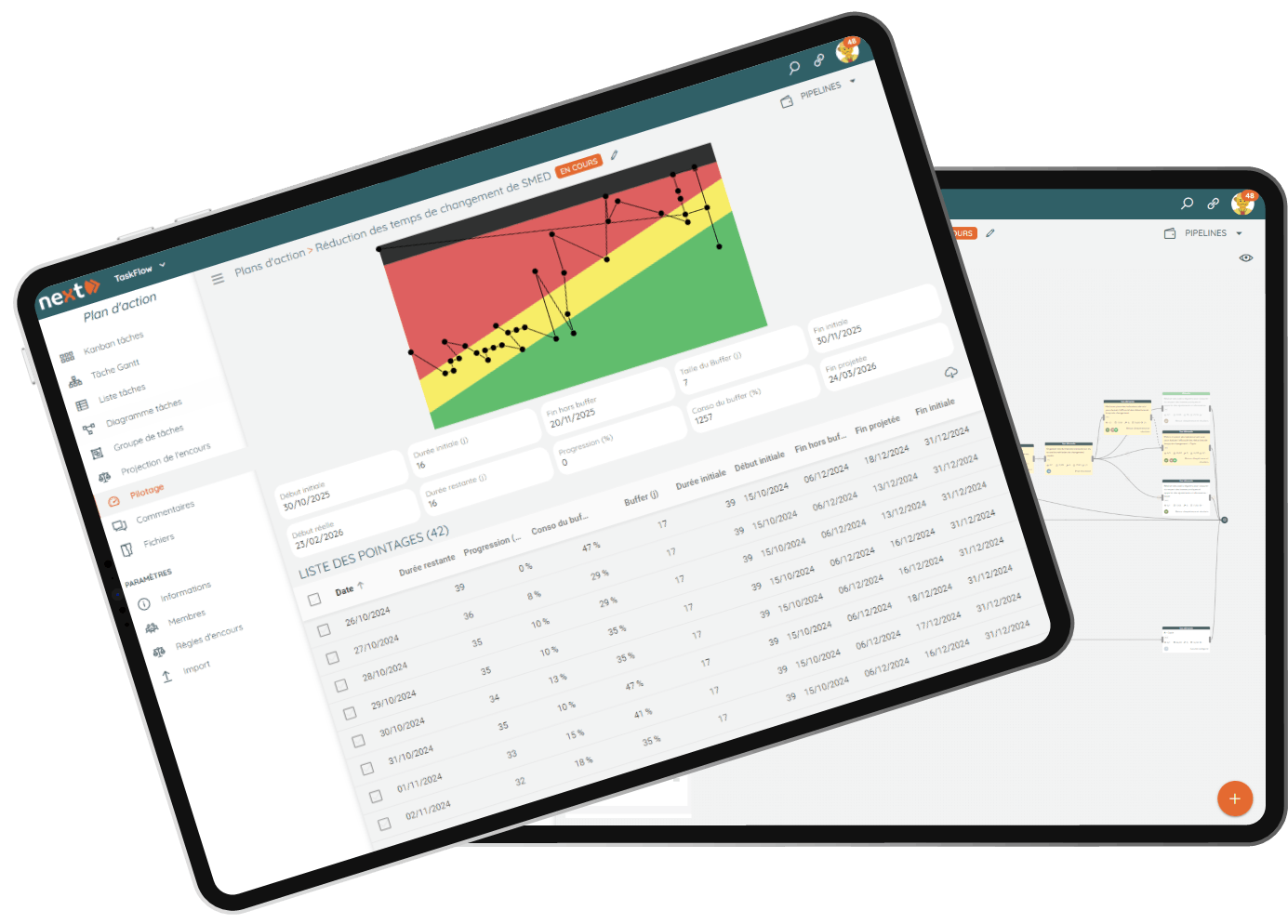
The Fever Chart gives everyone — team and management — the same green / yellow / red / black reading.
Works across every sector: R&D, NPD, engineering and portfolio management.
The CCPM method
Fever Chart
Health at a glance
Buffers
Variability absorbed
Constraint
Bottleneck-centred plan
Portfolio
WIP under control
A shift in approach
Visual project health indicator
A single chart ties critical chain progress to buffer consumption. Every stakeholder gets an immediate, unambiguous health signal. No spreadsheets, no interpretation — a shared view to decide faster and more clearly.
Green zone
The buffer is consumed more slowly than progress. The project is healthy.
Yellow zone
The buffer is catching up with progress. Review the risks and secure the dependencies.
Red zone
Over-consumed relative to progress. Make a fast, collective management decision.
Buffer exhausted
Buffer ≥ 100 %. The end date is no longer protected: immediate recovery plan.
Features
A real-time health indicator linking critical chain progress to buffer consumption. One chart, one shared truth for the whole team.
Pooled, visible protection against variability. Early alerts, built into the flow.
Sequence and prioritize around the bottleneck resource — plan where reality hits first.
Identify prerequisites, prevent premature starts and curb multitasking.
Instant portfolio view, multi-project health and WIP capped at the portfolio level.
Manage remaining duration rather than % complete: more reliable, less biased, anticipates drift.
Measurable impact
Typical results observed on Critical Chain (CCPM) deployments.
20–50 %
Shorter lead times by curbing multitasking
Less
Stress and last-minute firefighting
More
On-time deliveries and predictability
1
Clear execution rule for the whole team
Results depend on scope, context and the discipline of adoption. No guarantee — orders of magnitude from real deployments confirmed by customers.
The SafeFlow support
Performance rests on implicit rules: when to start, how to change a priority, when to escalate. No software can enforce them on its own. SafeFlow, delivered by AGILEA, makes them explicit — training, coaching and facilitation turn rules into repeatable rituals.
Deployment, step by step
The 5 SafeFlow rituals
Secure all prerequisites before starting a task — zero premature starts.
Finish before you launch. Prioritize by buffer consumption, not by urgency.
Fever Chart + buffer focus, every week, no exceptions.
Pipeline + WIP to curb multi-project multitasking and stabilize priorities.
Red zone: a fast, collective and traceable decision — escalate early, decide together.
A discovery day “through play”: multitasking, buffers, arbitration. The fastest path to buy-in.
The inspiration
If Goldratt’s Theory of Constraints (TOC) resonates with you in supply chain, the same logic applies to projects: make the flow visible, protect the constraint, reduce multitasking.
Free resources
Critical Chain, buffers, reading the Fever Chart and a 5-step deployment roadmap.
Download — free8 videos to grasp the essentials: eliminate bad multitasking, synchronize resources, cut lead times dramatically.
Find our flow project management articles on the Agilea blog: case studies, method and best practices.
Read the articlesNEXT platform
TaskFlow shares a common data layer with the other NEXT applications — project management, flow analysis, field audits and skills — for a 360° operational view.
Flow-based project management
DemandAnalyser, Workspaces…
The NEXT ecosystem keeps growing.
They use it
TaskFlow changed the way we manage projects. Deliveries became faster and decisions simpler thanks to a shared health view.
The SafeFlow rituals made the difference — the tool works, but it’s the weekly review and the escalation ritual that changed behaviours.
We cut our project lead times by 35 % in the first year. The Fever Chart gave management a language everyone understood.
Frequently asked questions
A flow-based project management tool inspired by Critical Chain (CCPM): buffers, Fever Chart, multi-project views and simple rules to make project health visible and speed up decisions.
For project managers in industry, R&D and new product development (NPD), PMOs and portfolio management — especially when critical resources are shared and unstable priorities slow execution down.
No. TaskFlow isn’t centred on constant replanning. It’s used to manage execution by reading health (buffers + Fever Chart) and through more stable priority arbitration.
A shared, visible protection that absorbs variability and protects the end date — instead of hidden margins scattered across every task.
Yes, because prioritization becomes factual (buffer / constraint) rather than political. It curbs premature starts, reduces context-switching and increases the number of completed tasks.
TaskFlow is the tool. SafeFlow is the deployment and facilitation package: method, rules, rituals, training, coaching and facilitation to embed the practices on the shop-floor.
Execution performance rests on implicit rules (WIP, start decisions, priority changes, escalation). SafeFlow makes them explicit and turns them into repeatable rituals supported by coaching.
Weekly health review (Fever Chart + buffers), priority arbitration (finish before you launch), Full Kit ritual (secure the prerequisites), portfolio review (pipeline / WIP) and escalation ritual (red zone: a fast, collective, traceable decision).
Yes. SafeFlow applies the same principles (flow, WIP, simple signals, visual management) to the project world through Critical Chain, buffers and more stable decision governance.
Ready to take back control?
A demo on a real case (industry, R&D, NPD, portfolio) is enough to validate the fit between the method, the rituals and the tool.
Release notes
NEXT evolves continuously. Here are the platform's most recent versions.