
Skip to content

Starting February 23, you can access your NEXT application via the URL dedicated to your company, as indicated in the email you received.
If you run into any trouble, contact our support: support.platform@agilea-group.com

NEXT app · Skills & cross-skilling

Map the key skills

An operational skills matrix, built on declarative self-assessment: set target levels per role, visualize the gaps and prioritize upskilling actions.

Skills matrix Targets per role Built & hosted in France
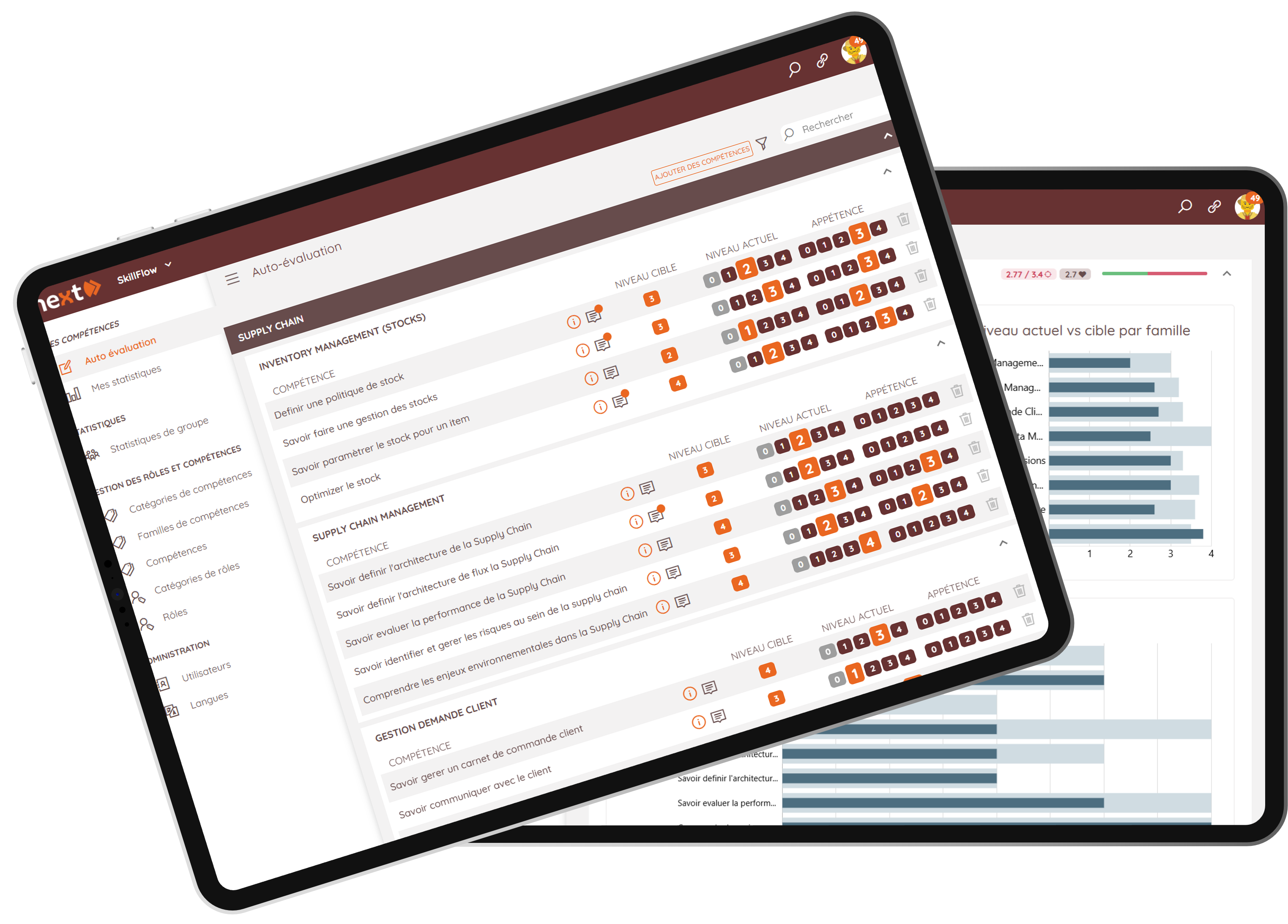
SkillFlow interface: skills versatility matrix

The challenge

Who can do what?
Nobody has the full picture

Skills live in managers’ heads and in scattered spreadsheets. The result: invisible vulnerabilities, training plans decided by guesswork, and key skills that hang on a single person.

01

Invisible skills

No overall view.

Who masters what, and at what level? The information is scattered — in managers’ heads, in spreadsheets that quickly go stale. A shared reading of it is impossible.

02

Hidden vulnerabilities

One sole holder = a risk.

A key skill carried by a single person is a breaking point. Without a map, you find out the day they’re away — or they leave.

03

Training by guesswork

No target, no gap.

Without required levels or visible gaps, training plans are decided on instinct — not where the operational need is truly greatest.

The solution

Cross-skilling, visible at a glance

SkillFlow brings your teams’ skills together in a living matrix: everyone declares their levels, the manager validates, and the targets per role surface the gaps. Visual management, not paperwork: easy to maintain, readable on the shop-floor.

  • A skills matrix

    See at a glance who masters what, and at what level, by team and by role.

  • Declarative self-assessment

    Everyone positions themselves on their know-how; the manager validates. Lightweight, empowering, always current.

  • Targets per role & gaps

    Set the required levels per role: the gaps to close stand out immediately.

Configurable, without the overhead

Your skills framework

Skill families, know-how and levels specific to your trade. You define the grid and the targets; SkillFlow handles the matrix and the gaps.

Skill families
Know-how
Levels
Targets per role
Roles
Teams

How it works

From the grid to targeted actions

Four steps to move from an outdated spreadsheet to upskilling steered where it really matters.

1

Define the framework

Skill families, know-how and levels specific to your trade.

2

Set the targets per role

The required level for each role, skill by skill.

3

Assess (self-declared)

Everyone positions themselves, the manager validates. The matrix stays current.

4

Prioritize the actions

Close the critical gaps and secure the at-risk skills.

The matrix

Cross-skilling, in a single table

Who masters what, and at what level. At a glance: the strengths, the gaps and the skills that hang on a single person.

At-risk skill

“Data” hangs on a single person. Spot the breaking point, secure the know-how.

Gap to target

Compare the level reached against the level required per role — the shortfalls jump out.

Instant reading

The darker the cell, the higher the level. Visual management, no spreadsheet.

Audit Flow Lean Project Data Léa 4 3 2 4 1 Marc 2 4 4 1 3 Inès 3 2 4 2 1 Tom 1 3 2 4 1 Sofia 2 1 3 2 4
Beginner Expert

Features

Map, target, level up

Key feature

Skills matrix

Who masters what, and at what level — team by team, role by role. A single view, readable on the shop-floor, that makes cross-skilling steerable.

Audit Flow Lean Project Data Léa Marc Inès Tom
02

Declarative self-assessment

Everyone declares their levels, the manager validates. Lightweight, empowering, always current.

03

Targets & gap-to-target

Set the required level per role; the gaps to close stand out at a glance.

04

At-risk skills

Spot the critical know-how carried by a single person — and secure it.

05

Visual management

A simple view, readable on the shop-floor, with no administrative overhead.

06

Configurable framework

Skill families, know-how and levels fully configurable.

Measurable impact

Cross-skilling finally steerable

Typical results observed when deploying the skills matrix.

100 %

Of skills mapped on a common, shared grid

Fewer

Critical know-how items carried by a single person

More

Cross-skilling, right where it truly secures production

1

A shared view of skills, kept current by the teams

Results depend on scope, context and adoption discipline. No guarantee — orders of magnitude confirmed by real deployments.

NEXT platform

Part of the NEXT ecosystem

SkillFlow shares a common data layer with the other NEXT applications — project management, flow analysis, field audits and skills — for a 360° operational view.

They use it

Cross-skilling under control

In a single morning, we saw that three key skills hung on a single person. We launched the training right away — the risk is now steered.
Production Manager
Self-assessment changed everything: the teams took ownership of the matrix, it stays current on its own. No more spreadsheet that nobody maintained.
Shop-floor Manager
The targets per role make the gaps obvious. Our reviews and training plans finally rest on facts, not impressions.
HR Manager · Industry

Frequently asked questions

Skills & cross-skilling

What is SkillFlow?

The skills and cross-skilling mapping app of the NEXT ecosystem. You configure a framework (skill families, know-how, levels), everyone self-assesses, and the skills matrix makes visible who can do what — with targets per role and the gaps to close.

What is a skills matrix?

A table cross-referencing people (or roles) with skills, with a mastery level per cell. It shows at a glance a team’s know-how coverage, the areas of vulnerability (a single holder) and the room for progress.

Is declarative self-assessment reliable?

It is an empowering starting point, not a verdict: everyone declares their levels, the manager validates or adjusts. This two-step process keeps the matrix current, light to maintain, and far more alive than a spreadsheet held by a single person.

How do you set the targets per role?

For each role, you set the required level on each skill. SkillFlow compares the level reached against the target and surfaces the gap — per person, per role, per team.

Does SkillFlow replace an HR / workforce-planning tool?

No, it equips them on the shop-floor side. SkillFlow focuses on operational cross-skilling and visual management — lightweight, with no administrative overhead. It complements your HR/workforce-planning efforts rather than replacing them.

Can it be adapted to our trade?

Yes. Skill families, know-how, levels, targets and vocabulary are fully configurable. The matrix speaks your language, which makes adoption easier for the teams.

Is SkillFlow part of a larger platform?

Yes. It fits into Agilea’s NEXT ecosystem, alongside TaskFlow (flow-based project management), FlowAnalyzer (flow analysis) and ProcessEval (audits & maturity). The apps share a common data layer, for a 360° operational view.

Ready to map your skills?

Make skills visible

Discover how SkillFlow maps your teams’ cross-skilling — to secure the key know-how and target upskilling where it counts.

  • No commitment
  • Skills matrix
  • Visual management

What are you looking for?

Type a keyword to search the entire site.