
Process mining & flow reality
FlowAnalyser
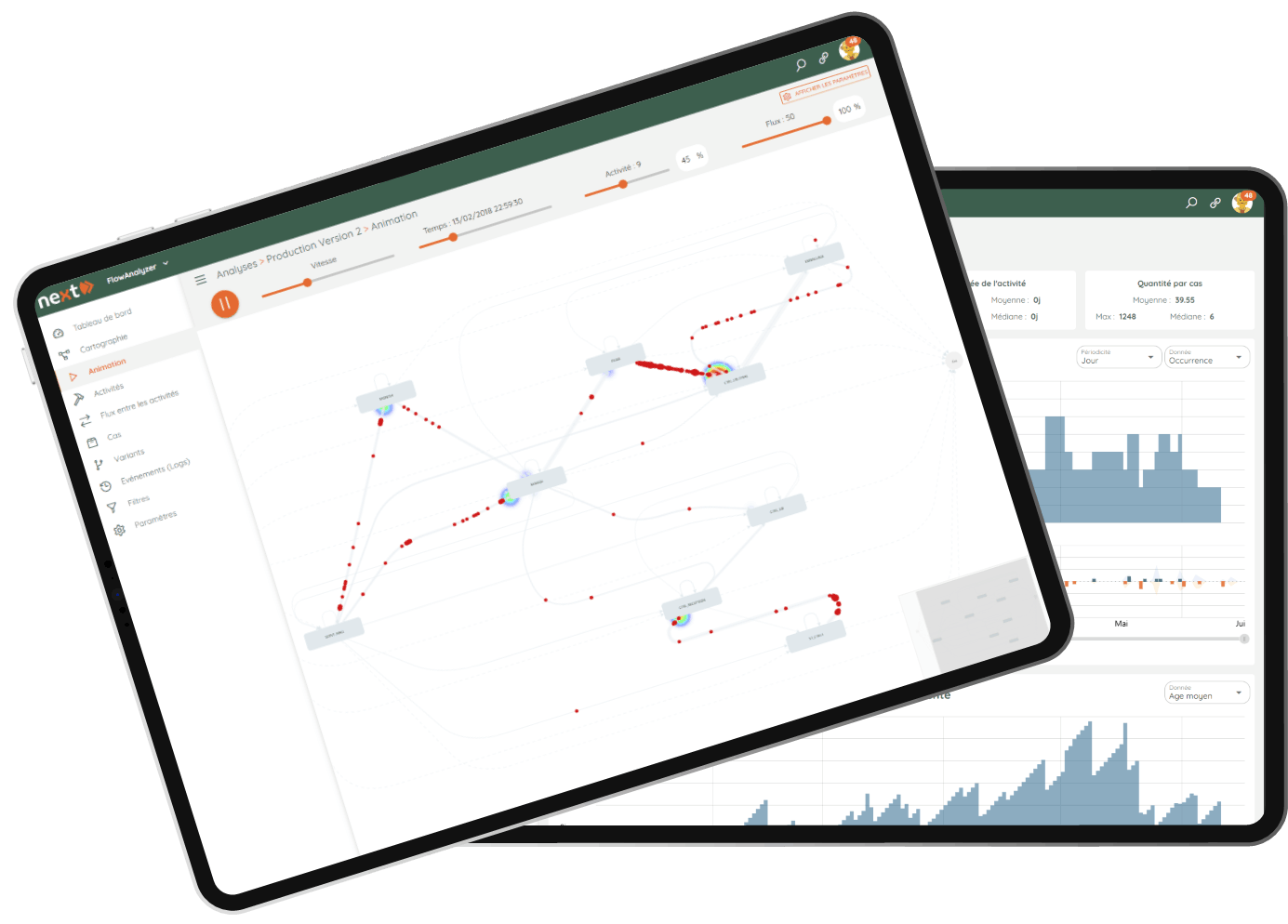
Reveal the reality of your flows — data‑driven!
Rebuild your flows from your own data to visualize tensions, delays and rework — and prioritize actions where impact will be greatest.
The Challenge
Visibility is often perception‑based.
Organizations often lack fact‑based visibility on how their flows actually behave. Tensions, accumulated delays and rework stay hidden behind averages or opinions — making it hard to prioritize improvement actions.
Opaque flows
No real visibility
Actual flow behavior stays invisible in classic averages. Tensions, delays and rework hide behind aggregated KPIs and assumptions.
Misplaced priorities
No shared view
Without a clear view of the longest cycles, teams don’t know where to focus. Improvement efforts scatter instead of targeting the highest‑impact flows.
Variability and rework
Invisible loops
Rework loops, instability and long cycles stay buried in “average” KPIs. Variability is the silent killer of flow performance.
The FlowAnalyser Solution
Reconstruct the flow as it is really executed.
FlowAnalyser reconstructs your flows using logs and data exports (ERP, MES, CRM, etc.). It highlights flow intensity, longest cycles, and variability so you can see where tensions concentrate and steer improvement actions.
No black box.
Just readable data.
No automatic recommendations — the tool makes the data readable and discussable. Import, reconstruct, measure, explore — and align teams on facts.
Flow reconstruction
Map the process as executed — not just as designed. Reconstruct actual paths from event logs.
Key measures
Lead time, waiting time, rework, WIP, variability — all computed from your real data.
Interactive views
Filter by product, customer, period, team, channel. Drill down into what matters most.
Visual cues
Highlight tension zones, accumulated delays, and high variability areas. See what was previously invisible.
Team learning
Visual maps make problems obvious and trigger action. Drive better discussions with shared, factual views.
Measurable impact
Visibility improves when data replaces opinions.
Typical outcomes observed in flow analysis deployments — context and adoption discipline drive the results.
100%
Fact‑based visibility
on actual flow behavior
↓↓
Reduced time identifying
tensions and rework
↑↑
Faster team alignment
on improvement priorities
1
Shared factual view
for all stakeholders
Results depend on scope, context, and adoption discipline. No guarantee — confirmed by real deployments.
Key features
No black box. Just readable data.
Import, reconstruct, measure, explore — and align teams on facts.
Data import
Load event logs and system exports (ERP, MES, CRM, etc.).
Flow reconstruction
Map the process as executed — not just as designed.
Interactive views
Filter by product, customer, period, team, channel.
Metrics & indicators
Lead time, waiting time, WIP, loops/rework, variability.
Visual cues
Highlight queues, friction points, and high variability areas.
Learning support
Maps make issues obvious and drive better discussions.
Testimonials
Teams that transformed their flow visibility.
"The flow maps helped us see exactly where waiting time was building up and align the team on a few simple, high‑value actions."
"Before FlowAnalyser, we debated endlessly about priorities. Now we have a shared, factual view that drives faster decisions."
"We identified rework loops we didn’t even know existed. The visual maps made problems obvious and triggered immediate action."
Integrated into the NEXT Ecosystem
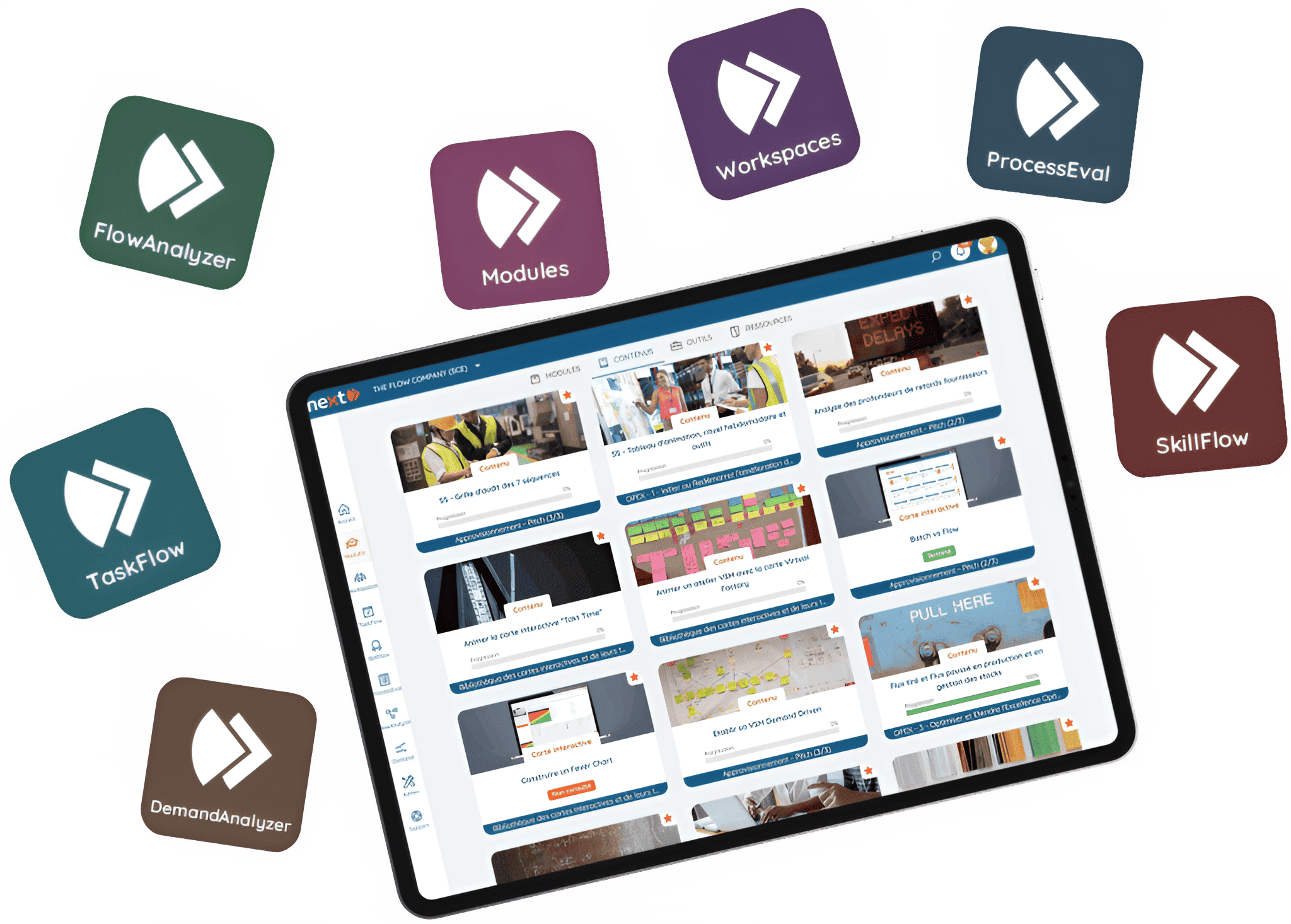
FlowAnalyser is one of the applications available within NEXT, designed to leverage your data and provide a clear, shared view of your flows. To go further, ProcessEval can be used for on‑site audits and detailed assessment, while TaskFlow supports structuring and managing improvement projects.
FAQ
Frequently asked questions
Everything you need to know about process mining, flow analysis and FlowAnalyser.
What is process mining?
Process mining is a data-driven discipline that reconstructs and visualizes actual business processes from event logs recorded by information systems (ERP, MES, CRM, etc.). Unlike traditional process mapping — which relies on interviews and assumptions — process mining reveals what really happens: the routes taken, the time spent at each step, case-to-case variability and rework patterns. It gives teams an objective foundation for improvement.
What is FlowAnalyser?
FlowAnalyser is Agilea’s process mining application. It ingests your event logs and reconstructs a visual map of your actual flows — showing intensity, cycle lengths, delay accumulation and rework loops. Designed for operational teams, it turns opaque data into a clear, shared picture that drives informed decisions.
What types of processes can be analyzed with process mining?
Process mining applies to any process that leaves a digital trace: manufacturing orders, purchase-to-pay, order-to-cash, patient pathways, IT ticket handling, logistics workflows and more. Whether your flows are industrial, administrative or service-oriented, process mining makes them visible and measurable.
Why analyze actual flows instead of relying on process documentation?
Process documentation describes how things should work. In practice, flows drift: workarounds appear, exceptions become routine, and unofficial paths emerge. Process mining captures the reality — every variant, every delay, every rework loop — so improvement efforts start from facts, not assumptions.
What data does FlowAnalyser need?
FlowAnalyser uses event logs and system exports from your existing tools: ERP, MES, CRM, LIMS, ticketing systems, etc. Each row represents a timestamped event linked to a case (order, ticket, batch…). No complex integration or additional sensors are required — your systems already record what FlowAnalyser needs.
How is process mining different from a classic BI dashboard?
A BI dashboard displays aggregated KPIs — averages, volumes, completion rates. Process mining reconstructs the individual path of each case to reveal the routes taken, case-to-case variability and tension zones. It shows the ‘how’ behind the numbers — information that stays invisible in standard reporting.
How does process mining support lean and continuous improvement?
Lean and CI methodologies rely on objective observation of flows (gemba, value stream mapping). Process mining digitizes this observation at scale: it surfaces cycle time variability, rework patterns and waiting zones across thousands of cases, giving lean teams a factual starting point for every kaizen or DMAIC cycle.
Does FlowAnalyser compare actual times to theoretical targets?
FlowAnalyser focuses on the reality observed in execution data. It does not benchmark against a theoretical model or standard times. The goal is to make flows readable and discussable so teams can identify improvement levers themselves — starting from what actually happens, not from what should happen.
How quickly can I get a first flow map?
Once data is imported, FlowAnalyser reconstructs flows within minutes. Preparation time depends on the quality and availability of your event logs, but a first readable flow map is typically available within a few hours — giving your team an immediate, factual basis for discussion.
Is FlowAnalyser part of a broader platform?
Yes. FlowAnalyser is integrated into Agilea’s NEXT ecosystem, alongside TaskFlow (flow-based project management), ProcessEval (on-site audits), SkillFlow (skills management), DemandAnalyser (demand analysis) and Workspaces (collaborative spaces). Each application shares a common data layer, enabling a 360° operational view.
Make your flows readable
Discover how FlowAnalyser lays out your flows so you can make fast, well‑informed decisions with your teams.